Short on time? Get the quick version.



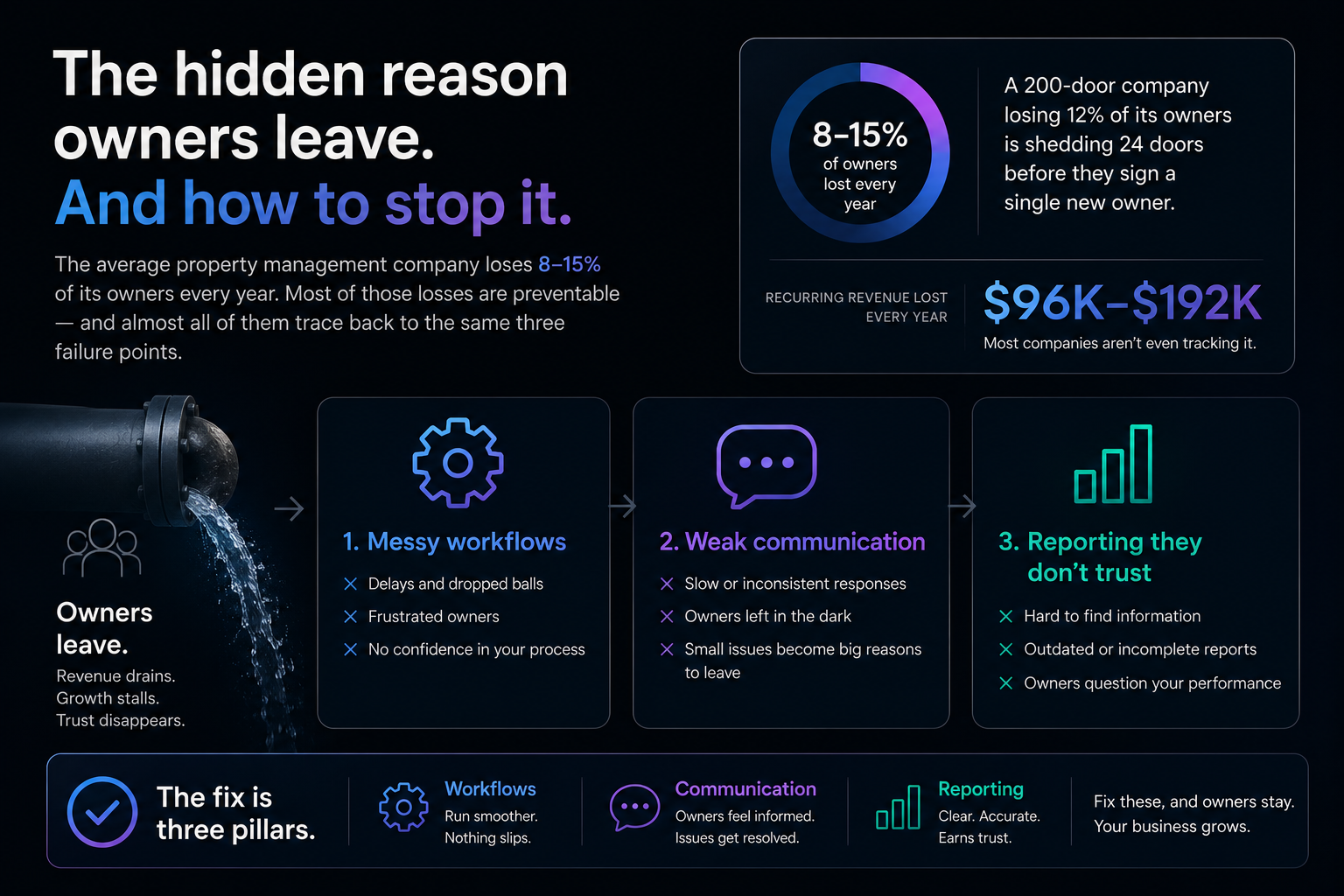
The average property management company loses 8 to 15% of its owners every year. Most of those losses are preventable — and almost all of them trace back to the same three failure points: messy workflows, weak communication, and reporting that owners don't trust.
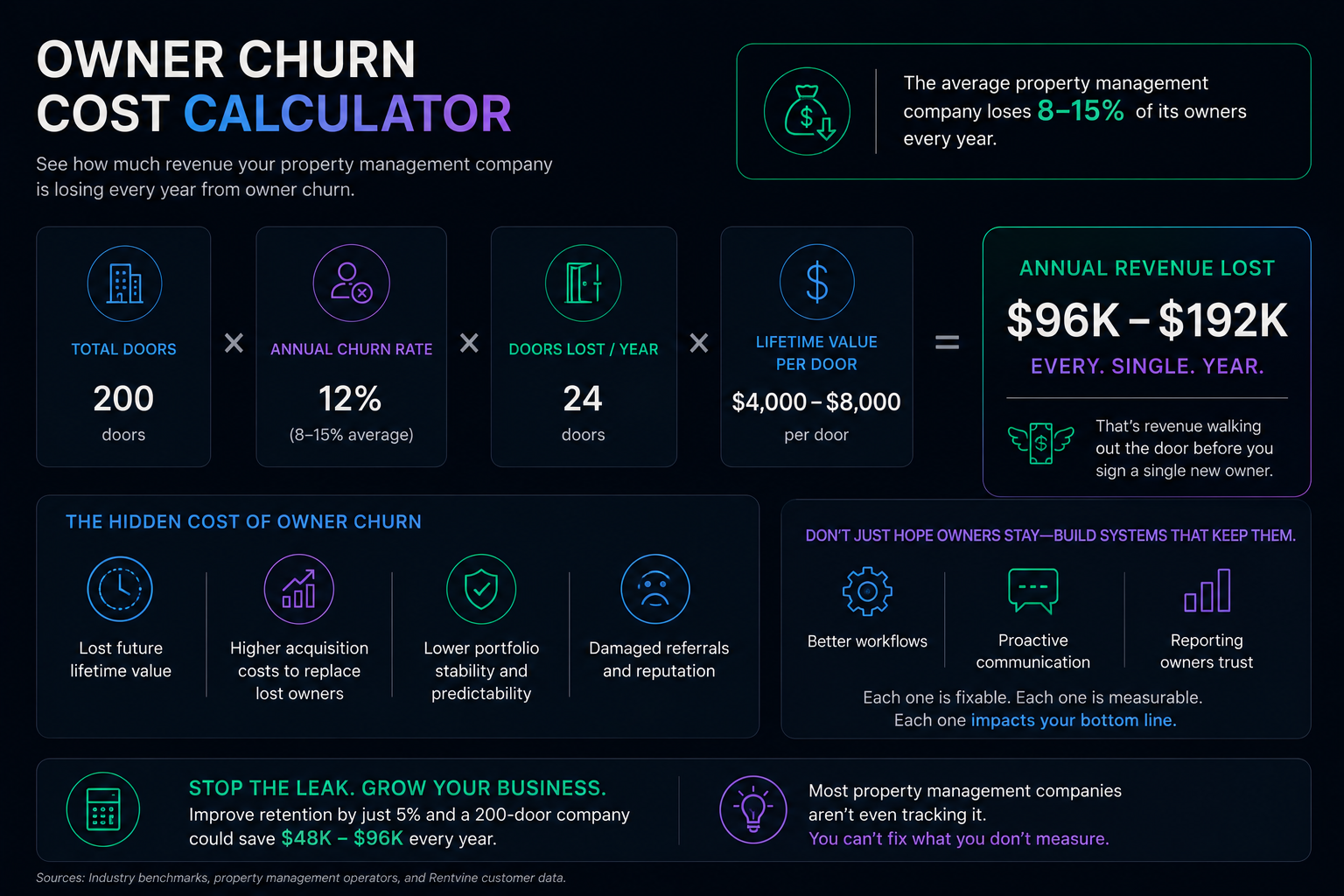
The math on that is brutal. A 200-door company losing 12% of its owners annually is shedding 24 doors before they sign a single new owner. At a lifetime value of $4,000 to $8,000 per door, that's $96K to $192K of recurring revenue evaporating every year — and most property management companies aren't even tracking it.
This isn't a "be nicer to your owners" article. Owner retention isn't about being nicer. It's about building operational systems that make owners' lives easier — and giving them visibility that earns their trust before they have a reason to look elsewhere.
The fix lives in three pillars: workflows, communication, and reporting. Each one is fixable. Each one is measurable. And each one is a place where the property management software you use either helps you or actively gets in the way.
Why owner retention is the most underrated KPI in property management
Owner retention is the single most leveraged operational metric in property management — and it's the one most companies don't track.
Three reasons that matter:
The math is brutal. Acquiring a new owner costs five to ten times more than retaining one. Lost owners often take their portfolios with them — multiple doors at once, sometimes a dozen.
Most property managers don't measure it. They track door count growth as a net number, which masks churn. A company "growing" 50 doors a year while losing 80 is shrinking — and they don't know it. Net growth is a vanity metric. Owner retention rate is the truth.
Owner churn compounds. Owners talk to other owners. Bad reputations travel through investor networks faster than they used to, and review platforms now feed AI tools that summarize you to the next prospect before you ever get the call.
If you don't know your owner churn rate, you don't have an owner retention strategy. You have hope.
The three reasons owners leave (and what they all have in common)
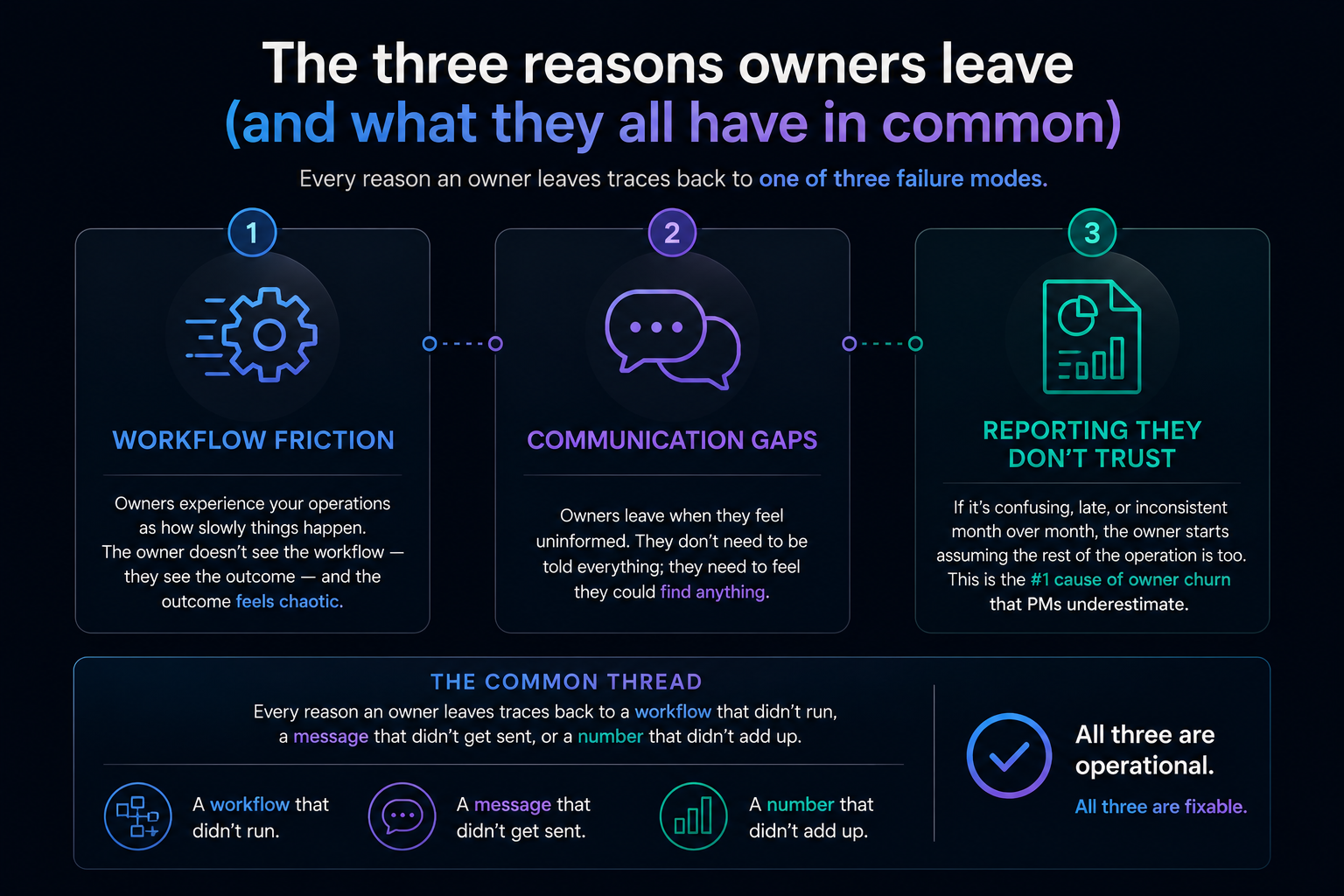
Every reason an owner leaves traces back to one of three failure modes.
Reason 1 — Workflow friction
Owners experience your operations as how slowly things happen. Maintenance tickets that drag on for days. Lease renewals that miss the window and create vacancy. Move-outs that take weeks to settle and turn into deposit disputes. The owner doesn't see the workflow — they see the outcome — and the outcome feels chaotic.
Reason 2 — Communication gaps
Owners leave when they feel uninformed. They don't need to be told everything; they need to feel they could find anything. The gap between "I'm sure they're handling it" and "I have no idea what's going on" is where churn lives.
Reason 3 — Reporting they don't trust
The owner statement is the artifact of trust. If it's confusing, late, or inconsistent month over month, the owner starts assuming the rest of the operation is too. This is the single most common cause of owner churn that property managers underestimate.
The common thread across all three: every reason an owner leaves traces back to a workflow that didn't run, a message that didn't get sent, or a number that didn't add up. All three are operational. All three are fixable.
Pillar 1 — Workflows that protect the owner experience
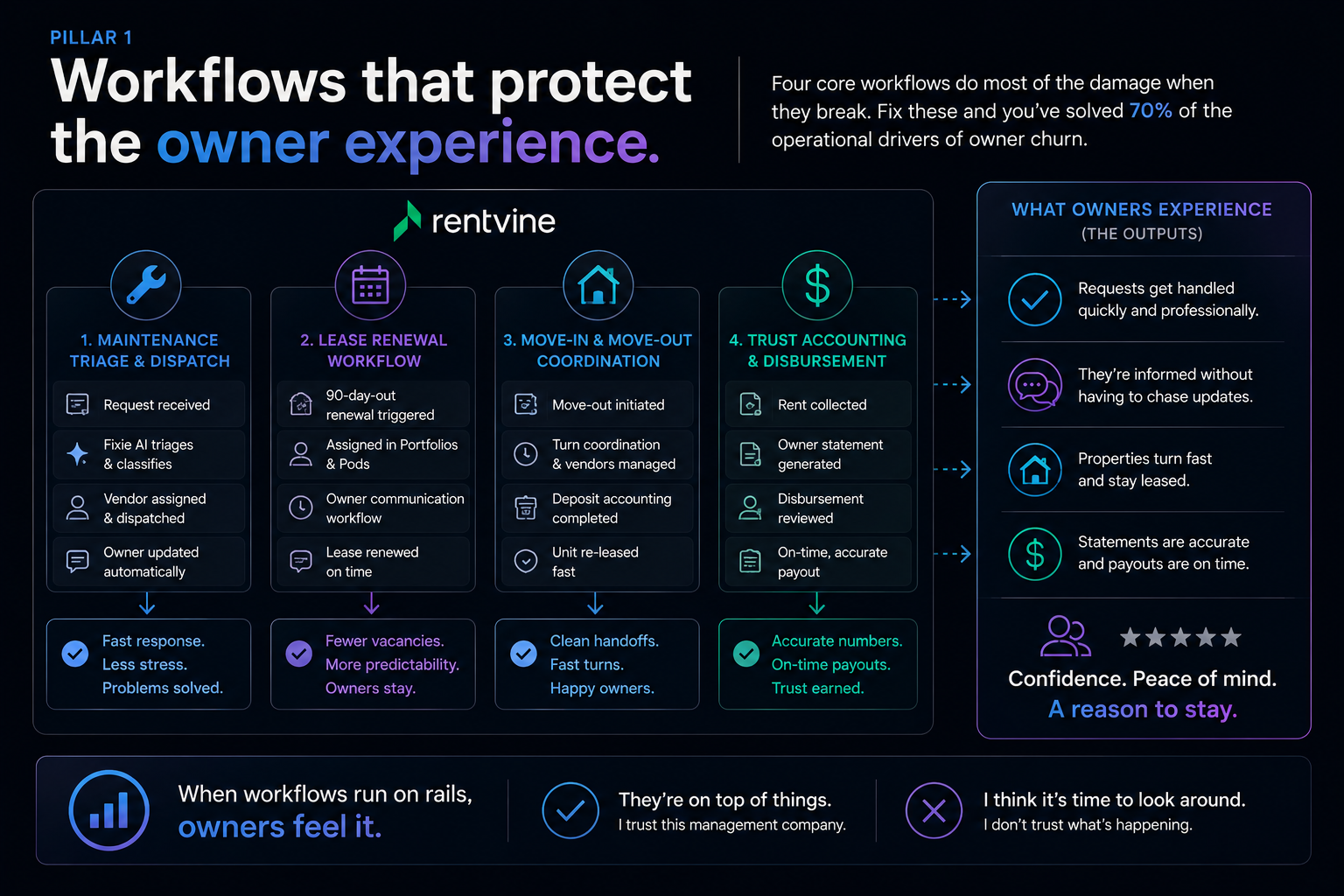
The fastest way to improve owner retention is to fix the workflows that owners feel — even though they never see them.
Four workflows do most of the damage when they break. Fix these and you've solved 70% of the operational drivers of owner churn.
Maintenance triage and dispatch
Slow maintenance is the number one driver of owner complaints, full stop. The benchmark to hit: under two hours to triage, under 24 hours to dispatch a vendor for non-emergency work. Most property management companies miss those numbers because triage happens in a human inbox, not a system.
This is exactly where AI is rewriting the playbook. Fixie, Rentvine's maintenance AI agent, triages incoming requests, classifies severity, drafts owner communications, and dispatches vendors — without making the operations team grow.
Lease renewal workflow
Vacancy is the moment owners start questioning you. The 90-day-out renewal cadence is non-negotiable: 90 days before lease end, the renewal conversation should already be in motion.
Portfolios & Pods in Rentvine assigns renewals to a specific team member with no ambiguity about ownership. Renewals don't get dropped because there is no "someone should handle that" — there is a name.
Move-in and move-out coordination
The most chaos-prone workflow in property management. Move-out, security deposit accounting, turn coordination, and re-leasing all stack on top of each other in the same two-week window. Owners expect a clean handoff, a fast turn, and accurate deposit accounting.
When trust accounting and operational workflows live in the same system, this stops being a fire drill. When they're bolted together across multiple tools, it always is.
Trust accounting and disbursement
Late or inaccurate disbursements are the fastest way to lose an owner. There is no operational mistake an owner notices faster than a wrong number on the statement.
Native trust accounting — built directly into the property management system, not bolted on — eliminates the most common disbursement errors. Owners feel this even when they don't know what to call it.
When workflows run on rails, owners feel it as "they're on top of things." When workflows leak, owners feel it as "I think it's time to look around."
Pillar 2 — Communication that earns trust before owners ask for it
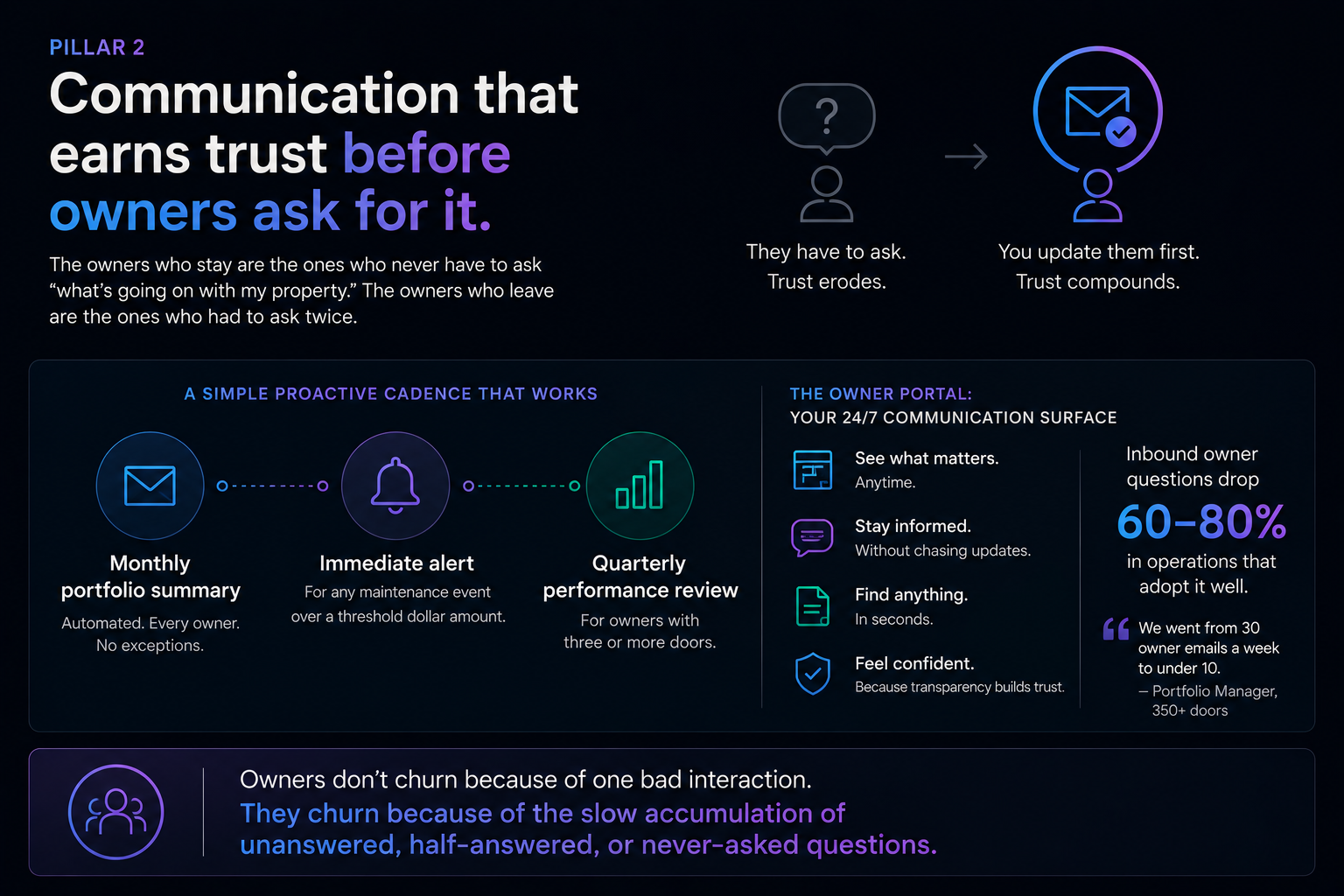
The owners who stay are the ones who never have to ask "what's going on with my property." The owners who leave are the ones who had to ask twice.
Communication is where most property management companies have the biggest gap between intent and execution. Everyone knows they should communicate more. Almost nobody has a system for it.
Proactive vs. reactive communication
The retention difference is the gap between "I emailed them when they asked" and "they emailed me before I knew there was a question." Most platforms force property managers into reactive mode because the data is buried until someone requests it.
A simple proactive cadence that works:
- A monthly portfolio summary email — automated, every owner, no exceptions
- An immediate alert for any maintenance event over a threshold dollar amount
- A quarterly performance review for owners with three or more doors
That cadence alone, if you actually run it, separates retention-grade operations from the field.
The owner portal as a communication tool
An owner portal isn't a feature on your website. It's a 24/7 communication surface, and what an owner sees the moment they log in determines whether they trust you.
Live financials. Open work order status. Document access. Statement history. Year-to-date performance. When Rentvine's Interactive Portals are surfacing all of that the second an owner logs in, inbound owner questions drop 60–80% in operations that adopt it well.
[Customer quote — e.g., "We went from 30 owner emails a week to under 10 after we put the owner portal front and center." Anchors the section with a real number.]
Maintenance status communication
Owners don't need every detail. They need to know something is being done. Automated status updates pulled directly from the work order system close that gap.
This is another place where AI shines. Rentvine AI can generate clear, owner-friendly summaries from technical work orders without an ops team member rewriting them by hand. The owner gets the update; nobody wrote it from scratch.
Anniversary and milestone touches
Three communications, automated and in place, do disproportionate work for retention:
- The 90-day check-in with new owners (the highest-risk window)
- The annual portfolio review with key owners
- The first-of-year tax document delivery, with a proactive walkthrough
Set up once in the workflow, these run themselves. Every year. For every owner.
Owners don't churn because of one bad interaction. They churn because of the slow accumulation of unanswered, half-answered, or never-asked questions.
Pillar 3 — Reporting that owners actually trust
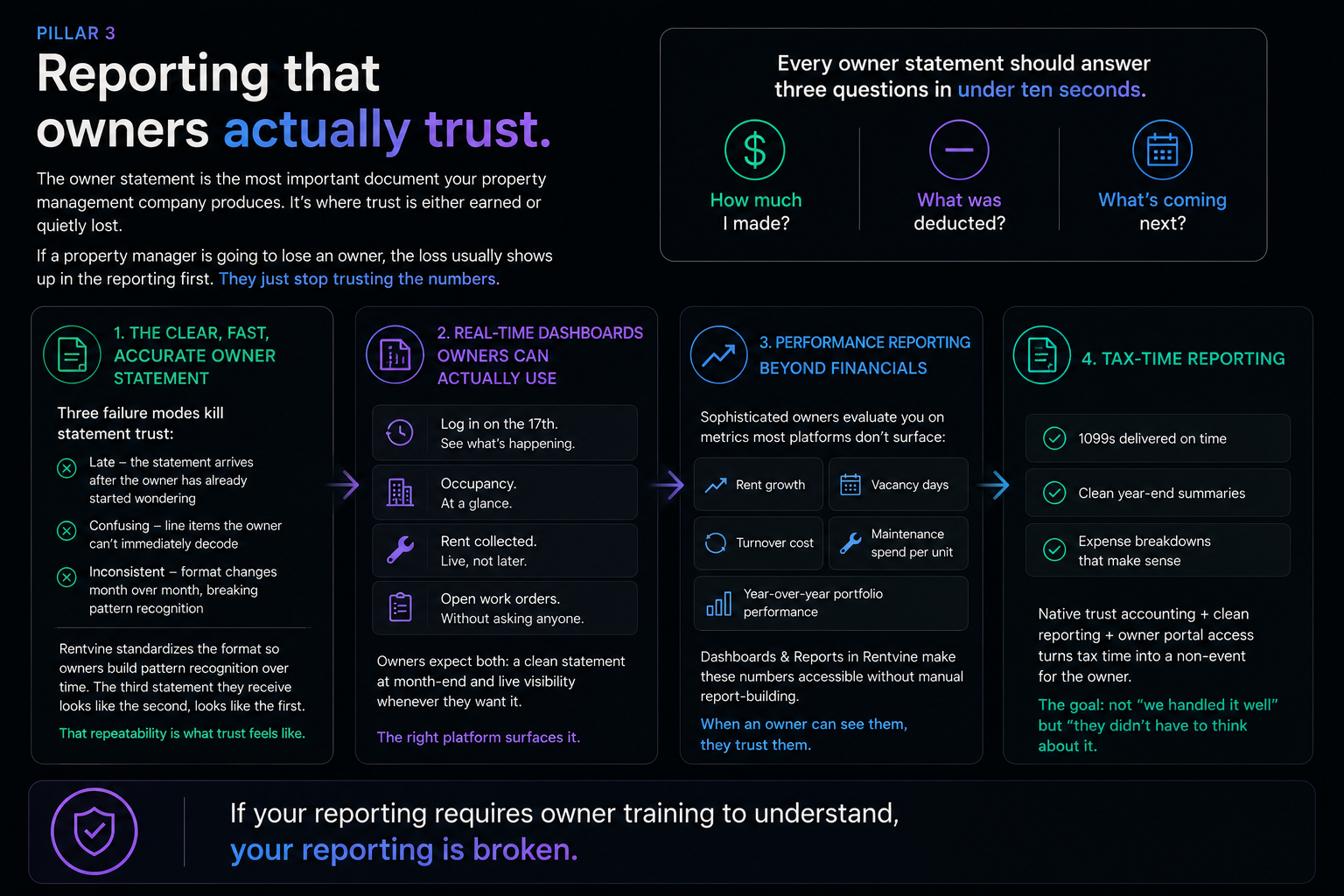
The owner statement is the most important document your property management company produces. It's the only artifact most owners look at every month — and it's where trust is either earned or quietly lost.
If a property manager is going to lose an owner, the loss usually shows up in the reporting first. The owner doesn't necessarily say it out loud. They just stop trusting the numbers, and once that's gone, retention is gone.
The clear, fast, accurate owner statement
Every owner statement should answer three questions in under ten seconds: how much I made, what was deducted, what's coming next.
Three failure modes kill statement trust:
- Late — the statement arrives after the owner has already started wondering
- Confusing — line items the owner can't immediately decode
- Inconsistent — the format changes month over month, breaking pattern recognition
Rentvine's Owner Statements standardize the format so owners build pattern recognition over time. The third statement they receive looks like the second, looks like the first. That repeatability is what trust feels like.
Real-time dashboards owners can actually use
The shift from "monthly statement" to "live dashboard" is already underway. Owners increasingly expect both. They want the statement at month-end, but they also want to log in on the 17th and see occupancy, rent collected, and open work orders without asking anyone.
Most platforms hide this from owners. The right platform surfaces it.
Performance reporting beyond financials
Sophisticated owners — especially investors with multiple doors — evaluate property management companies on metrics most platforms don't surface: rent growth, vacancy days, turnover cost, maintenance spend per unit, and year-over-year portfolio performance.
Dashboards & Reports in Rentvine make these numbers accessible without manual report-building. When an owner can see them, they trust them. When they can't, they assume the worst.
Tax-time reporting
Tax season is the highest-stakes communication moment of the year. 1099s, year-end summaries, expense breakdowns, deductible categorization — get any of this wrong and the owner remembers. Forever.
Native trust accounting plus clean reporting plus owner portal access turns tax time into a non-event for the owner. That's the goal: not "we handled it well" but "they didn't have to think about it."
If your reporting requires owner training to understand, your reporting is broken.
How AI is changing owner retention in property management
AI is reshaping owner retention faster than any operational shift in the last decade — because it makes proactive communication, fast workflows, and clear reporting cheap enough to do at scale.
For most of the last 20 years, the property management companies with the best owner retention were the ones with the most senior staff and the highest cost structure. AI is rewriting that equation.
A few use cases that are already in production:
- AI-summarized owner statements that explain the numbers in plain English alongside the line items
- AI maintenance triage (Fixie) that delivers faster owner updates without growing the team
- AI-drafted owner communications that maintain proactive cadence even on portfolios with thousands of doors
- Pattern detection across owner sentiment, work order history, and statement engagement to flag at-risk owners before they cancel
Property managers using AI well in 2026 are widening the retention gap on those who aren't. The operational floor has moved.
The property management companies that will own the next five years aren't the ones with the lowest fees. They're the ones whose AI-powered operations make owners feel taken care of without paying a premium for it.
A 90-day owner retention plan you can start this quarter
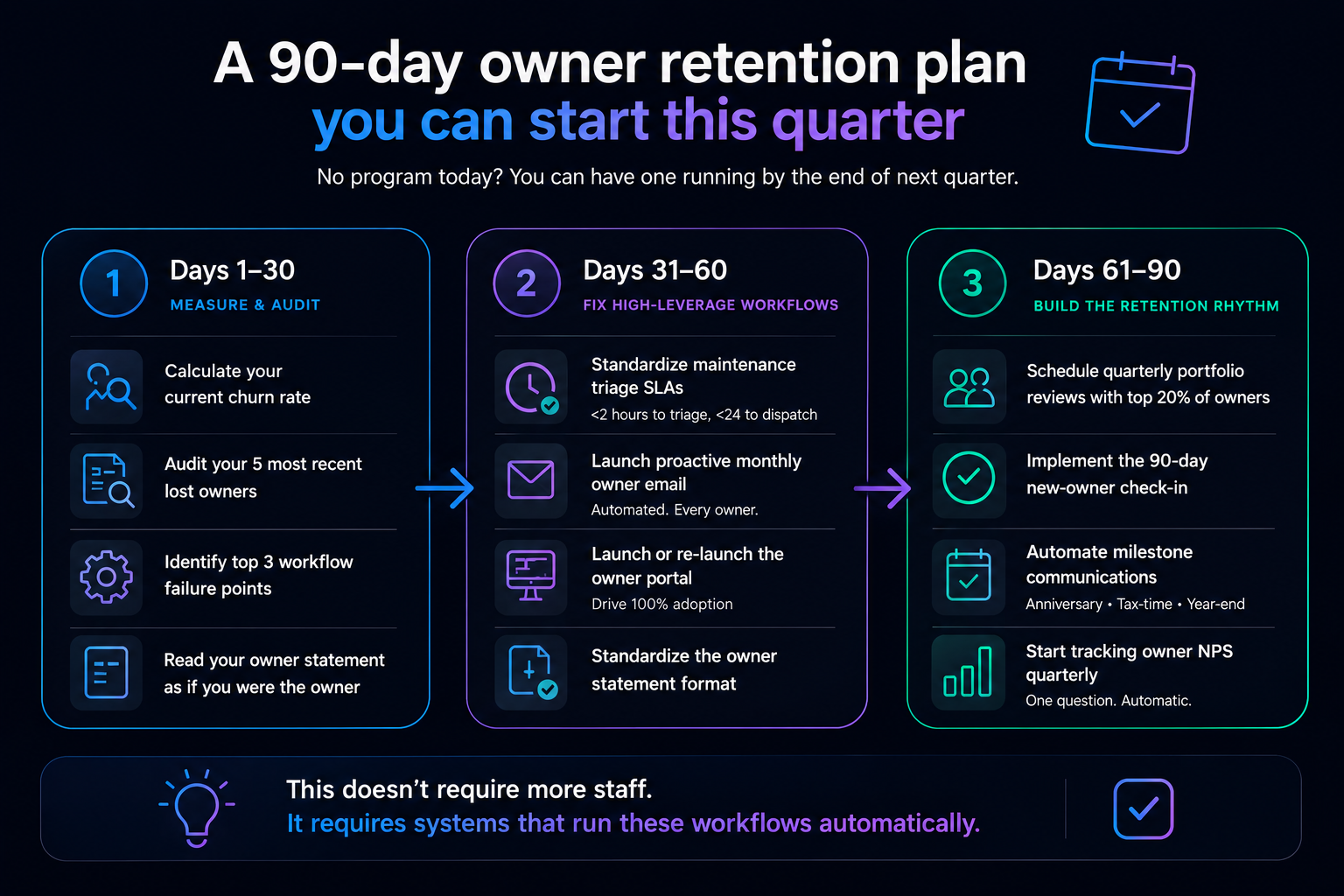
This isn't a strategy. It's a calendar. If you don't have an owner retention program today, you can have one running by the end of next quarter.
Days 1–30: Measure and audit
- Calculate your current owner churn rate. Lost owners ÷ starting owners over the last 12 months × 100. If you don't know the number, that's the first problem.
- Audit your five most recent lost owners. What was the reason given? What was the reason underneath the reason given? Exit interviews if possible.
- Identify the top three workflow failure points. Ask your operations team — they'll name them in under five minutes.
- Audit your own owner statement. Print one. Read it as if you were the owner. Would you trust it?
Days 31–60: Fix the highest-leverage workflows first
- Standardize maintenance triage SLAs. Target: under two hours to triage, under 24 hours to dispatch.
- Implement the proactive monthly owner email. Automated, every owner, no exceptions.
- Launch (or re-launch) the owner portal. Verify every owner has logged in at least once. Run a campaign to drive adoption if they haven't.
- Standardize the owner statement format. No more month-over-month inconsistency.
Days 61–90: Build the retention rhythm
- Schedule quarterly portfolio reviews with your top 20% of owners by door count.
- Implement the 90-day new-owner check-in.
- Set up automated milestone communications — anniversary, tax-time, year-end summary.
- Start tracking owner NPS quarterly. One question, sent automatically, scored over time.
None of this requires hiring more staff. All of it requires the operational tooling to make these workflows automatic — which is exactly the gap most property management software fails to fill.
Frequently asked questions
What is a good owner retention rate for property management companies?
A healthy owner retention rate in property management is 90% or higher annually — meaning fewer than 10% of owners leave each year. Industry average sits around 85–88%. Top-performing operations exceed 95%.
Why do property owners leave property managers?
Property owners typically leave for three reasons: workflow failures (slow maintenance, missed renewals, settlement delays), communication gaps (feeling uninformed about their property), and reporting they don't trust (confusing or late owner statements). Each one traces back to an operational system, not a personality issue.
How often should property managers communicate with owners?
A monthly portfolio summary at minimum. Immediate alerts for maintenance events over a threshold. A quarterly performance review for portfolio owners with three or more doors. An annual strategic review. The exact cadence matters less than running it consistently.
What should be in an owner statement?
Opening balance, rent collected, expenses with clear categorization, management fee breakdown, net distribution, closing balance, year-to-date summary, and a single-line "what's next" note. Standardized format month over month so owners can read it in under ten seconds.
How can property management software improve owner retention?
The right platform automates proactive communication, surfaces real-time financials in an owner portal, generates clean and standardized owner statements, and runs maintenance and renewal workflows on schedule — without requiring the property manager to remember every step.
How do I calculate owner churn rate in property management?
Owner churn rate = (owners lost during period ÷ owners at start of period) × 100. Run it monthly for trend, annually for benchmark. Track it as carefully as door count.
What's the difference between owner retention and tenant retention?
Owner retention is keeping the property owner as a client of your management company. Tenant retention is keeping renters in the property. Both matter, but owner retention has a higher financial impact because each lost owner can mean multiple lost doors at once.
Can AI help with owner retention in property management?
Yes. AI assists with faster maintenance triage (Fixie), proactive owner communications, AI-summarized owner statements, and pattern detection across owner sentiment to identify at-risk owners before they leave. The retention gap between AI-enabled and non-AI-enabled property management companies is widening every quarter.
How does Rentvine help with owner retention?
Rentvine combines the workflows (Portfolios & Pods, native trust accounting, integrated maintenance), the communication layer (Interactive Owner Portals, Rentvine AI), and the reporting (Owner Statements, Dashboards & Reports) in one platform — eliminating the integration tax that prevents most property managers from running a real retention program.
What's the ROI of investing in owner retention?
Reducing owner churn from 12% to 6% on a 500-owner book is worth approximately 30 retained owners per year. At $4,000–$8,000 lifetime value per owner, that's $120K–$240K in retained recurring revenue, every year, compounding. The ROI on retention investment is almost always higher than the ROI on acquisition.
The bottom line
Workflows. Communication. Reporting. Three pillars, three systems, three places where owner retention is either built or lost. Each one is operational. Each one is measurable. And each one stops being a wishlist item the moment a property management company has the platform to make it routine.
The property management companies that will dominate the next decade aren't the ones with the most aggressive growth playbook. They're the ones whose existing owners never have a reason to leave.
[Dave Borden founder quote tying the three pillars back to Rentvine's mission of giving property managers the platform to operationalize retention without integration headaches.]
— Dave Borden, Founder, Rentvine
Ready to operationalize owner retention?
See how Rentvine combines workflows, communication, and reporting in one platform → Schedule a Rentvine demo
Download the 90-day owner retention plan as a PDF you can hand your operations team → Get the plan
Related from Rentvine
Custom notifications in Rentvine