

Short on time? Get the quick version.



“Trust accounting” might sound like a term invented by accountants to make the rest of us feel bad about our QuickBooks skills, but it is actually one of the most important parts of running a legitimate property management business. If you manage money that belongs to other people like owners, tenants, or vendors, you are legally and ethically required to handle it with care. That is what trust accounting is all about.
At its core, trust accounting is not complicated. It simply means keeping other people’s money separate from your own. When you collect rent, security deposits, or owner contributions, those funds must be deposited into a special type of bank account called a trust account. You are essentially the middleman, not the owner of the funds. You are a referee, ensuring that money goes to the right place at the right time.
If that sounds simple, it is, but it is also incredibly easy to mess up. A small error can lead to big consequences like lost licenses, regulatory fines, or, in extreme cases, criminal penalties. So understanding how to set up, maintain, and reconcile a trust account is not just good practice; it is survival.
What Is Trust Accounting, Really?
Imagine you are holding a friend’s wallet. You can carry it for them, but you cannot use it to buy coffee or pay your Netflix bill. The same logic applies to trust accounts. The funds are in your possession but not your property. You are holding them “in trust” until they are properly disbursed.
This includes rent payments from tenants, security deposits, reserve funds for repairs, and contributions from owners. Those dollars must be tracked with precision and kept entirely separate from your company’s operating funds.
When done correctly, trust accounting provides a clear, traceable record of who paid what, when it was received, where it went, and whether the balances line up to the penny. It is about transparency and accountability, two words that auditors love and property managers sometimes fear.
Why Trust Accounting Matters
It is easy to assume that good intentions are enough. After all, if you are not stealing, what is the big deal? Unfortunately, regulators do not see it that way. Even accidental errors in trust accounting can trigger audits, penalties, or disciplinary action.
Mixing client money with your own, known as commingling, is one of the most common mistakes. Even a temporary “I’ll just move this to cover that bill and replace it later” can be considered a violation. The moment you use a trust account for anything outside its purpose, you are in dangerous territory.
In California, the Department of Real Estate (DRE) requires property managers to perform monthly reconciliations and maintain detailed ledgers for each property and owner. The state can audit these records at any time, and if you cannot produce clean documentation, the presumption is not in your favor. Arizona takes a similar approach, requiring that every transaction in a trust account be traceable to its source and purpose.
The stakes are high because these funds represent people’s homes, investments, and livelihoods. Mishandling them undermines the foundation of trust that property management depends on.
The Anatomy of a Proper Trust Account
A good trust accounting setup looks like a pyramid with multiple layers of detail. At the top is the master trust account, a single bank account where all client funds are deposited. Beneath that, there are sub-ledgers that track how much of that total belongs to each owner or property. These ledgers record every transaction, from rent payments to vendor bills to owner distributions.
You also maintain tenant records, showing who has paid rent, who owes late fees, and what portion of their payments were applied to which accounts. Finally, there are your management fees, which are only transferred from the trust account after you have confirmed that everything reconciles and that owner balances are accurate.
At the end of each month, three numbers must match perfectly: the bank statement balance, your journal balance, and the sum of all sub-ledgers. If even one of those figures is off, something is wrong, and you need to find out why before moving on.
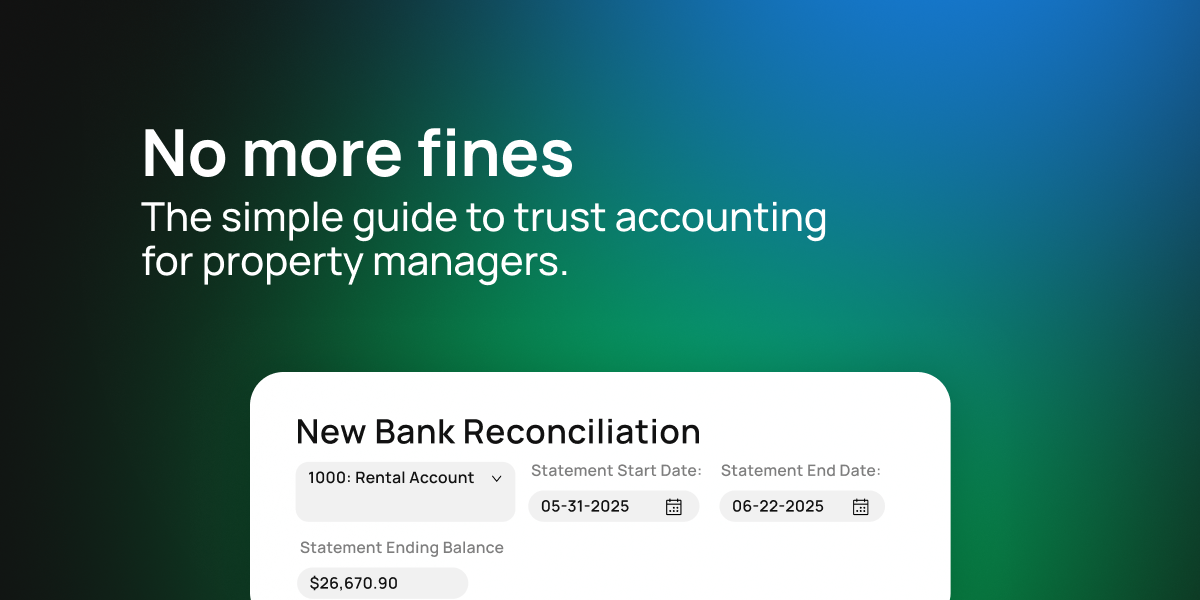
How to Reconcile Your Trust Accounts
- Match the ending bank statement balance to your cash journal
- Add outstanding deposits, subtract outstanding checks to get the adjusted bank balance
- Sum all owner and property sub-ledgers to a period total
- Confirm bank equals journal equals ledger, investigate any variance
- Save reconciliations, statements, and source docs to your audit archive
The Daily Reality of Trust Accounting
In practical terms, trust accounting means tracking all inflows and outflows with painful accuracy.
Money coming in includes tenant rent payments, security deposits, and owner contributions for maintenance or capital projects. Money going out includes vendor payments, owner draws, refunds, and security deposit returns.
Every transaction should be logged with enough detail that an auditor could pick up your books and immediately understand the story of each dollar.
When done correctly, trust accounting becomes a routine part of your workflow. When ignored, it becomes a crisis waiting to happen.
The Common Pitfalls
The most frequent trust accounting mistakes are almost always avoidable. They usually happen when a manager is too busy, too confident, or too casual. Here are the usual suspects:
Commingling funds. Paying for business expenses or vendor invoices out of the trust account, or worse, depositing trust money into your business account, is a violation everywhere.
Forgetting to reconcile. Skipping even one monthly reconciliation makes the next one harder. Skip three, and you will be guessing instead of balancing.
Applying rent incorrectly. If Tenant A’s payment gets credited to Tenant B’s account, you have just overpaid one owner and underpaid another. That creates a cascading mess that takes hours to fix.
Not holding reserves. If you transfer an owner’s distribution before paying upcoming bills, the trust account can dip into negative territory, which looks like mismanagement even if the intention was good.
Poor documentation. If you cannot explain what a transaction was for or when it occurred, auditors will not assume the best.
The Solution: Systems, Not Stress
The good news is that modern software makes trust accounting far easier than it used to be. Platforms like Rentvine, integrate trust compliance directly into the workflow, reducing the risk of error.
Automation handles the repetitive parts, recording transactions, running three-way reconciliations, flagging discrepancies, and generating owner statements. These tools can detect when a ledger goes negative or when a transaction was misapplied. They maintain a complete audit trail so that every deposit, disbursement, and adjustment is traceable.
Think of it like a digital safety net. It does not replace your responsibility, but it makes compliance much easier to achieve and maintain.
The Property Manager Payoff
Trust accounting might seem tedious, but it offers a hidden benefit: credibility. When you can show owners transparent financials, precise records, and fast reconciliations, you build trust that leads to retention and referrals. Owners care deeply about knowing that their money is safe, their bills are paid, and their reports are accurate.
It also gives you peace of mind. Knowing that your books are balanced and compliant means you can focus on growing your business instead of dreading the next audit or wondering whether you missed a decimal point in last month’s reconciliation.
Final Thoughts
Trust accounting is not glamorous. Property Managers will not win awards for it, and you will never trend on social media because your bank statement is reconciled to the penny. But it is the backbone of responsible property management. It protects owners, tenants, and you.
The rules are straightforward. Keep client money separate, reconcile monthly, maintain clear records, and never assume “close enough” is good enough.
In the end, trust accounting is about integrity. It proves that you are not just collecting rent, you are managing responsibility. When you do it right, nobody notices, and that is exactly how it should be.