Short on time? Get the quick version.



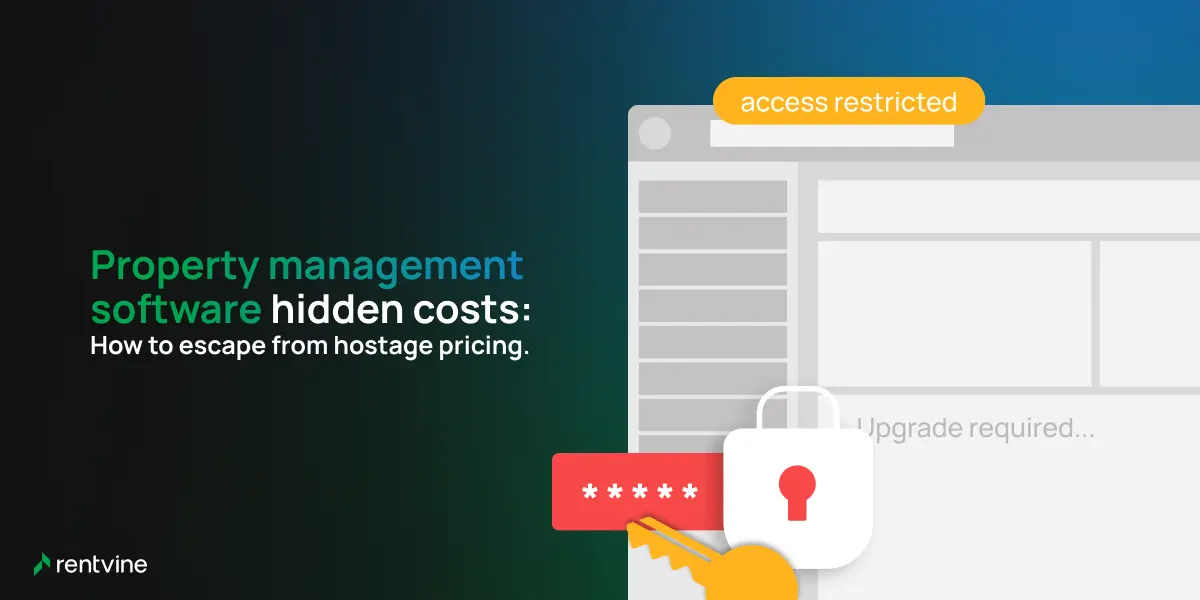
If you feel trapped by your software, it’s not an accident
What starts as an affordable, easy-to-adopt solution often becomes more expensive, more restrictive, and harder to rely on over time. Costs increase, support declines, and key features sit just out of reach unless you upgrade.
This is not poor execution. It’s a business model.
This isn’t a product problem. It’s a strategy.
Many property management platforms are optimized for one thing: maximizing revenue after you are locked in.
The playbook is consistent across the industry:
Win the deal with competitive pricing
Get your operations fully embedded in the platform
Gradually introduce friction, fees, and limitations
Make switching painful enough that you stay
That is why these patterns show up again and again. They are not isolated issues. They are deliberate.
If you want a baseline for comparison, review how modern platforms like Rentvine approach pricing transparency.
What “Hostage Software” actually looks like
These practices do not show up all at once. They reveal themselves as your dependence on the platform increases.
1. Support that gets worse when you need it most
During sales, everything is fast and responsive. During and after onboarding:
Response times slow down
Issues take longer to resolve
Priority support is paywalled
Support becomes a revenue stream, not a service.
Compare that to platforms like Rentvine that include support as part of the core product experience.
2. Onboarding that ends the moment you go live
You are pushed through onboarding quickly:
Limited training
Incomplete workflow setup
No long-term guidance
Once you’re live, the burden shifts to your team to figure it out.
3. Features that don’t match what was sold
Demos show ideal workflows and a full feature platform. Reality introduces:
Missing functionality
Workarounds for common tasks
Limitations that were not disclosed
Feature upsell or quantity thresholds
By the time you discover the gaps, you are already committed.
4. A roadmap that quietly stalls
Early on, the product feels active and evolving. Over time:
Feature releases slow down
Requests go unanswered
Innovation fades
The platform stops improving, but your business keeps growing.
Modern platforms are investing in automation and continuous improvement.
5. Closed systems that force you to stay inside their ecosystem
No open API means:
Limited integrations or API endpoints
No flexibility to choose best-in-class tools
Dependence on whatever the vendor offers
Required to pay more for API access or usage
You don’t just use the software. You’re handcuffed to it.
Platforms like Rentvine built with open architecture remove this limitation.
6. Tiered plans that keep you paying to operate normally
Essential features are not missing, they are gated:
Custom fields cost more
Features you need are only available at higher tiers
Reporting is limited or paywalled
Integrations require upgrades or fees
You are not upgrading for growth. You are upgrading to maintain functionality.
7. Costs that increase as you succeed
The more you grow, the more you pay:
Per-transaction fees
Per-document charges
Add-ons for core workflows
Your software becomes more expensive as your business becomes more successful.
See what Rentvine's all inclusive pricing looks like in practice.
The real cost isn’t fees. It’s loss of control.
These practices do not just increase your expenses. They limit how you operate.
You lose flexibility
Because integrations are restricted
You lose efficiency
Because workflows depend on workarounds
You lose leverage
Because switching becomes disruptive and expensive
At that point, staying is not a decision. It is the least painful option.
Why this model persists
If this sounds widespread, it is because it is.
Most property managers do not switch platforms, even when they are unhappy, because:
Migration is time-intensive
Retraining staff is disruptive
Data transfer carries risk
Vendors understand this dynamic.
That is why these models are built around customer inertia, not customer success.
How to avoid getting locked in
If you are evaluating software, do not just look at features. Look for constraints.
Ask directly:
What happens to pricing as I scale?
Which features require upgrades versus being included?
Is API access open or restricted?
What level of support is standard, not paid?
What does switching away actually look like?
If the answers are unclear, that is your answer.
Rentvine’s approach: Remove the leverage, don’t add to it
Rentvine is built on a different model. No dependency. No hidden leverage points.
What’s included
What that means in practice
You are not forced into upgrades to access core and advanced features
Your integrations are not restricted by usage
Your costs do not compound as you grow
Support is part of the product, not an upsell
Traditional vs transparent platforms
Traditional Property Management Software
Monetizes dependency
Gates functionality behind tiers
Restricts integrations
Charges more as you scale
Transparent Platforms
Include core functionality upfront
Keep pricing predictable
Enable integrations
Support your growth instead of taxing it
Key takeaways
Hostage software is a strategy, not a coincidence
Support, onboarding, and innovation gaps are part of the model
Tiered plans and closed APIs are designed to create dependency
Costs increase because switching is difficult
The alternative is software built to reduce, not exploit, lock-in
Ready to stop working around your software?
You shouldn’t have to upgrade just to function, pay extra for support, or stay because leaving is too painful. If your platform is creating dependency instead of leverage, it is worth rethinking.
Switch to a property management software built for control, flexibility, and growth. Head to Rentvine to schedule a demo.
Frequently asked questions
What are hidden costs in property management software?
Hidden costs include fees for e-signatures, payments, integrations, support, and feature upgrades that are not clearly disclosed upfront.
Why do software companies use hostage pricing?
To attract customers with low initial pricing and increase revenue over time through add-ons and lock-in.
What is included in all-in-one property management software?
Typically:
Accounting
Maintenance
Communication tools
Reporting
Integrations
However, some platforms charge extra for these features.
How can I avoid hidden fees?
Choose software with:
Transparent pricing
Included core features
Open API access
No tier-based restrictions
Is Rentvine all-inclusive?
Yes. Rentvine includes core features, support, and integrations without hidden fees or forced upgrades.
What is the average cost of property management software?
Most platforms charge $1–$5 per unit per month, but total cost is often higher due to add-ons and hidden fees.