Short on time? Get the quick version.



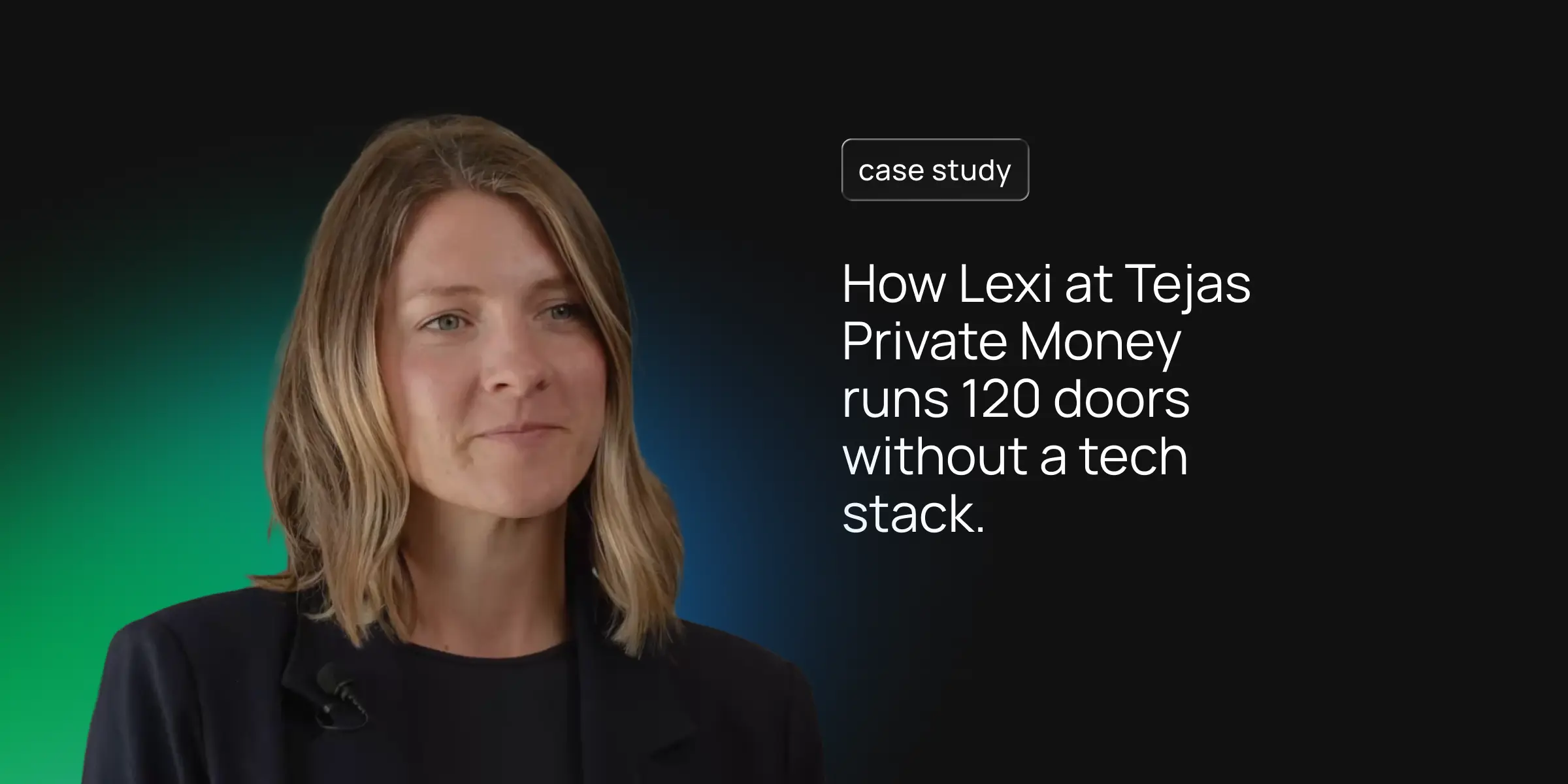
One person can manage a 120-door rental portfolio without hiring a team, if the software doesn't force them to compensate for it with a stack of separate tools. That's what Lexi at Tejas Private Money has proven. She runs her portfolio herself, about a quarter of it third-party managed, using Rentvine's property management platform instead of stringing together several disconnected systems.
What does it mean to manage a rental portfolio solo?
Managing a portfolio solo means one person handling accounting, tenant and owner communication, and day to day operations across every property, without a team splitting the work. Most property management software assumes a multi-person office and forces a solo operator to close the gap with extra tools bolted on the side. Rentvine is built as a single connected platform a solo operator can run start to finish, which is why Lexi has been able to grow to 120 doors without adding staff just to manage the software itself.
"I'm able to really connect with my tenants and my clients," Lexi said. That's the tradeoff a fragmented tech stack usually costs a solo operator first, less time for the relationships that actually keep a portfolio healthy.
Why did switching software matter for a company Lexi's size?
Lexi has close to 20 years in property management and has used a lot of different platforms in that time, including AppFolio, which she found genuinely difficult to learn. For someone running a portfolio without support staff behind her, a steep learning curve isn't a minor cost. It's hours she doesn't have.
"I found pretty quickly that everything I needed was in Rentvine," she said.
How did Lexi find Rentvine?
Lexi didn't find Rentvine through an ad. Three friends who'd stayed in the property management industry told her to check it out. She demoed it and knew right away it was the right fit.
What convinced her wasn't a feature list. It was the sense that the platform had been built by people who understood the job. "I felt like it was perfectly crafted by property managers who knew the business," she said, "not just a software that felt disconnected."
What does running a portfolio without a tech stack actually look like?
For a solo operator, every additional tool is another login and another workflow to reconcile by hand. Since moving to Rentvine, Lexi doesn't manage that anymore. "You don't have to go out and build a big tech stack," she said. "It's just all right there and ready to go."
That consolidation is what actually gives her time back. Blocking her own schedule and running the business herself, at a door count she once assumed would require help, comes down to not needing five different systems to manage one portfolio. For more on what a connected platform looks like at scale, see our guide to the best property management software for growing PM companies.
Why does Rentvine's product roadmap matter to a solo operator?
Lexi's confidence in Rentvine isn't only about what the platform does today. It's about where it's headed. "I love the prospects that y'all are rolling out," she said. "All of the new features that y'all are building are exactly what I would want, and I just feel like I'm on the right bus."
For an operator planning to run her business this way for years, that matters as much as day to day usability does.
Lexi's take
Asked whether she'd recommend Rentvine to another property manager, she didn't hesitate. "I would tell them 100%," she said. "It's everything you'll need. Easy to use, easy to start up with. I would tell them to go demo it today."
Frequently asked questions
Can one person manage 100 or more rental properties?
Yes. A solo property manager can run a portfolio of 100+ doors without hiring additional staff, provided the software handles accounting, communication, and maintenance coordination in one connected system rather than requiring several separate tools stitched together. Lexi at Tejas Private Money manages roughly 120 doors this way using Rentvine.
What software do solo property managers use to avoid hiring more staff?
Solo operators need a platform that consolidates the functions a small team would otherwise split up: trust accounting, owner and tenant communication, and maintenance tracking. Rentvine is built to run all of these from a single platform, which is why solo operators can take on more doors without proportional headcount.
How many doors can one property manager handle alone?
The realistic ceiling depends heavily on the software, not just the operator. A solo property manager relying on a patchwork of separate tools typically hits a wall well under 100 doors. With a connected platform like Rentvine that reduces manual reconciliation and coordination work, operators like Lexi manage well past that threshold by themselves.
What's the difference between a stitched-together tech stack and a connected platform?
A stitched-together tech stack means using separate tools for accounting, communication, listings, and maintenance, then manually keeping them in sync. A connected platform like Rentvine handles all of those functions natively, so there's no manual syncing step and no separate logins to manage.
Why did switching from AppFolio make a difference for a solo operator?
AppFolio requires a learning investment that's harder to absorb without a team to share it across. Property managers who've used AppFolio, including Lexi, have described it as burdensome to learn relative to platforms built with a lower learning curve. For a solo operator, that difference in ramp-up time translates directly into hours available for client and tenant work instead of the software itself.
The bottom line
Running a rental portfolio without a team isn't about working harder. It's about using software that doesn't require a team to operate. Lexi manages 120 doors by herself with Rentvine, and her advice to any property manager considering the same path is direct: "Go demo it today."\
Ready to see whether your portfolio could run this way? Schedule a demo.